
Brussels attacks add to political obstacles for Cameron
& Merkel
By Gregory Viscusi
By Gregory Viscusi
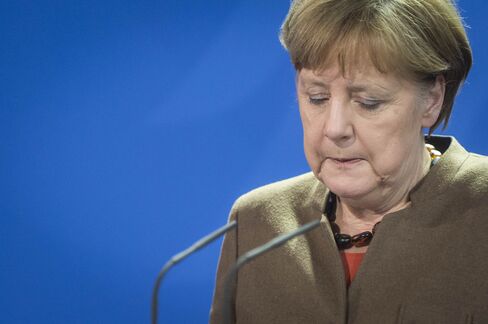

If David Cameron and Angela Merkel thought they had earned a
moment’s respite from their woes, the murderous attacks in Brussels only
deepened their political turmoil.The bombings at the heart of the European Union that killed
at least 31 people were seized upon by proponents of Britain leaving the bloc
to argue that EU membership puts the U.K. more at risk, rather than making it
safer as the prime minister asserts. In Germany, an insurgent party that
benefited from opposition to Chancellor Merkel’s open-door policy on refugees immediately
warned of the threat of “political Islam.”
The Brussels attacks may increase xenophobic and
anti-immigration sentiment across the EU, which has already been rising in
light of the EU’s refugee crisis, said Mujtaba Rahman, director of European analysis
at the Eurasia Group in London. That has implications both for the survival of
the passport-free Schengen area championed by Merkel and the outcome of the
U.K.’s in-out referendum on the EU in June, he said.
The blasts are a “nail in Schengen’s coffin,” and create the
perception among the public that EU leaders are “not in control,” Rahman said
in a Bloomberg Radio interview. Outside the Schengen zone in Britain, “Cameron
has argued that the U.K. will be safer in the EU, but these events will make
that narrative harder to sell.”
‘Lax’ Controls
Islamic State militants claimed responsibility for the
explosions, four days after Belgian authorities seized the chief suspect in the
Paris terror attacks that killed 130 people in November. Those assaults were
carried out by French and Belgian nationals at least some of whom who had
joined Islamic State in Syria, and made their way back to Europe along routes
used by Syrian refugees.
The U.K. Independence Party’s defense spokesman, Mike
Hookem, issued a statement saying the “horrific act of terrorism” in Brussels
showed that EU free-movement rules and “lax border controls” are “a threat to
our security.” UKIP campaigns for Britain to leave the EU, so-called Brexit.
Cameron, who on Monday had moved to heal rifts within his
Conservative Party, shot back in televised comments that “it’s not appropriate
at this time to make any of those sorts of remarks.” Yet even members of his
own party used the attacks to argue for a Brexit.
“Being in the EU means we don’t have control of our own
systems, we don’t have control over our own borders,” said Andrew Rosindell, a
Conservative member of parliament. “We are effectively tied to countries which
I think are not as good at protecting their people as we have been.”
Creating Divide
Security forces will focus on uncovering the network that
bred the attacks, but failure to do so “would raise the risk of further such
attacks in continental Western Europe in the coming weeks and months,” IHS Country
Risk analyst Lora Chakarova and head of IHS Jane’s Terrorism and Insurgency
Centre Matthew Henman said in an e-mail. They said among Islamic State
objectives are “creating a divide between European states and their Muslim
minorities.”
People gather and light candles at the Place de la Bourse
People gather and light candles at the Place de la Bourse
Photographer: Christophe Petit Tesson/EPA
In Germany, Merkel’s personal and party approval ratings
have stabilized in recent weeks after declining on the back of her policy of
welcoming Syrian refugees. And while the anti-immigration Alternative for
Germany party scored record gains in regional elections this month, a poll on
Tuesday suggested support for Merkel’s Christian Democrats had risen after an EU
accord with Turkey aimed at controling the flow of migrants.
“Brussels reminds us: The perpetrators are the enemies of
all of the values that Europe stands for today and which we uphold together as
members of the European Union,” the chancellor said in Berlin, hours after
President Barack Obama and other leaders had responded to the attacks. “Our
unity is our strength, and that is how our free societies will prove stronger
than terrorism.”
The idea of European openness was undermined by Beatrix
Storch, a European Parliament member for Alternative for Germany, who wrote on
her Facebook page that “we have a problem in Europe, an imported problem.”
“The goal is to strike at and destroy our way of life, our
culture,” Storch said. “Let’s remember that we have our own culture, one that
bonds Germans with Germans and Europeans with Europeans. It’s been submerged by
all the babble about multiculturalism.”
Le Pen
Political use of the attacks wasn’t limited to Britain and
Germany. In France, National Front leader Marine Le Pen called in a statement
for a “vast police operation to occupy neighborhoods on the fringes of the
Republic to seize all the weapons and explosives that are there.” While no
polls have her winning the top office, surveys show Le Pen as the candidate who
could take the most votes in the first round of next year’s French presidential
elections. “Laxity has lasted too long,” she said.
The upshot for investors is that “EU geopolitical risk is
growing,” said Lena Komileva, founder and chief economist of London-based
research company G Plus Economics Ltd. The “tragedy for European civilization
that the Brussels attacks should be seen as collateral for Brexiters and those
wanting an EU breakup and the return of illiberal nationalism, from France to
Germany to the U.K.”
No comments:
Post a Comment